Cart
0





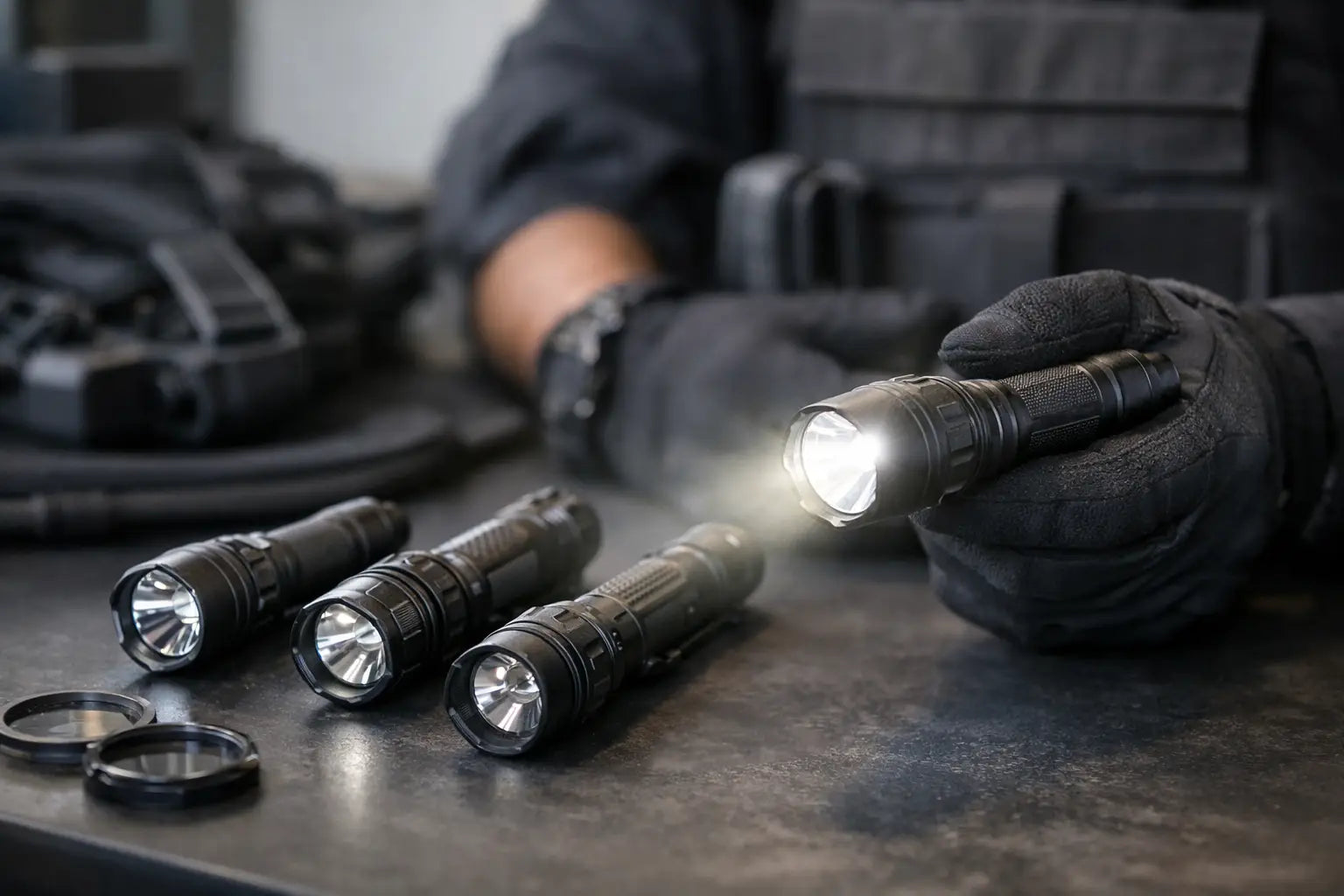
A duty light usually gets judged at the worst possible time - during a building search, a traffic stop, a dark stairwell, or a roadside medical call where you need to see clearly right now. That is why knowing how to select a duty light matters. The right light is not just bright. It has to match your job, your carry setup, and the way you actually work under stress.
A lot of buyers start with lumen count because it is easy to compare on a product page. Lumens matter, but they are only one part of the decision. A light that looks impressive in marketing can still be a poor duty choice if the beam is too wide, the switch is awkward with gloves, or the body is too bulky for your belt and daily movement.
How to select a duty light for real-world use
The first question is not, "What is the brightest light available?" It is, "What do I need this light to do on shift?" Patrol officers, private security professionals, corrections staff, fire and EMS personnel, and range users often need different things from the same category.
If you work patrol, you may need a stronger balance of throw and spill so you can identify a subject at distance while still seeing the area around them. If you work security at a fixed site or residential post, you may value compact size and long runtime over maximum output. If you are in fire or EMS, a duty light may need to work around gloves, wet conditions, and quick patient assessments where a harsh hotspot is less helpful than clean, even illumination.
That is where selection gets practical. A duty light is not just a flashlight with a tactical label. It is a tool you have to deploy fast, carry comfortably, and trust when conditions are bad.
Start with your use case, not the spec sheet
The best light for patrol is not always the best light for corrections or executive protection. Belt space, uniform setup, shift length, and policy requirements all matter. Before comparing models, think through how and where you will use the light most often.
A full-size duty light can be a strong choice if you spend a lot of time outside, conduct vehicle approaches, or need better reach in open areas. It gives you more battery capacity and often better thermal performance, which means it can sustain useful output longer. The trade-off is size. A larger light is harder to carry all day, especially if your belt is already crowded.
A compact light is easier to wear and quicker to stash in a cargo pocket, outer carrier pouch, or admin slot. That convenience is real, especially for security teams and supervisors who want a dependable light without extra bulk. The trade-off is usually shorter runtime and less reach at distance.
This is why there is no single best answer. The right pick depends on how much performance you need and how much size you are willing to carry every shift.
Lumens tell you part of the story
Higher lumens can help overwhelm dark spaces and improve scene awareness, but lumen numbers alone can be misleading. Two lights with similar output can perform very differently because of beam pattern.
A flood-heavy beam lights up a room, hallway, or vehicle interior well. It is useful for close work and general searches. A tighter beam with more throw helps with identification at distance, which can matter on perimeter checks, parking lots, wooded edges, or long commercial corridors.
Most duty users need a balanced beam. Too much flood can wash out distance. Too much throw can leave the near field dim and make close tasks awkward. If your work moves between indoor and outdoor environments, look for a beam that gives you both usable center intensity and enough spill to maintain situational awareness.
Candela matters more than many buyers expect
If lumens measure total light output, candela tells you how intensely that light is focused. For a duty light, candela is often what determines whether you can punch through darkness and get meaningful identification at range.
That does not mean everyone should chase the highest candela available. A very tight, high-candela beam can be excellent outdoors but less comfortable indoors, especially during prolonged use or close inspections. Again, it depends on the mission. Patrol and perimeter work may benefit more from higher candela than indoor security rounds or medical response.
Battery type and runtime affect real performance
Runtime matters because a light that starts strong but drops off fast can leave you managing battery anxiety halfway through a shift. You want enough sustained performance for your actual workday, not just a high number on turbo for a few minutes.
Rechargeable systems are popular for good reason. They can save money over time and simplify prep if you have a consistent charging routine at home, in the cruiser, or at the station. They are especially useful for heavy users who go through power quickly.
Disposable batteries still have a place. Some professionals prefer them because replacements are easy to carry and swap in the field. For certain users, especially those working long posts or irregular schedules, the ability to drop in fresh batteries without waiting to recharge is a practical advantage.
What matters most is consistency. Choose a power system that fits how you actually work. If you are not disciplined about charging, a rechargeable-only light may be a bad fit. If you do not want to stock spare cells, a disposable setup may become a hassle.
Switch design is not a small detail
A duty light has to be easy to activate under pressure. That means the switch matters just as much as brightness. Tail switches are common because they are intuitive, especially in traditional flashlight techniques and one-handed use. They can be a strong option for officers and security personnel who want fast momentary activation.
Side switches can be comfortable for general use, but they are not always ideal when speed and consistency matter most. Some lights combine both, which can work well if the interface is simple. If it takes too much thought to reach the mode you want, the light is already working against you.
This is also where gloves come into play. Fire, EMS, and cold-weather users should pay close attention to switch size, texture, and travel. A low-profile switch may look clean but feel frustrating in the field.
Mode selection should stay simple
Multiple brightness modes can be useful, but too many options create friction. For duty use, most professionals want immediate access to a strong primary mode and predictable controls. Strobe can be valuable for some users, but it should not interfere with standard activation.
If a light cycles through several settings every time you press it, think carefully before making it your primary duty tool. In administrative or recreational use, that may be acceptable. On shift, simple usually wins.
Durability, retention, and carry matter every day
Duty lights take abuse. They get dropped, exposed to rain, knocked against door frames, and carried through long hours in heat and sweat. Look for a light with solid construction, dependable sealing, and impact resistance that matches professional use.
Material matters, but design matters too. A durable body, good grip texture, and a secure bezel and lens all contribute to long-term reliability. If the light feels slick or fragile in hand, that is worth paying attention to.
Retention is another piece buyers sometimes overlook. A duty light should fit your carry method securely, whether that means a belt ring, pouch, pocket clip, or dedicated holder. A great light that shifts, snags, or disappears from your setup is not a great duty light anymore.
If your agency has policy requirements for size, color, rechargeable systems, or approved brands, check those before you buy. It is better to narrow your options up front than to end up with a light that never makes it onto your belt.
How to select a duty light without overbuying
There is a difference between buying for the job and buying for the spec war. The most expensive or highest-output model is not automatically the best choice. If your work is mostly close-range indoor security, you may get more value from a compact, well-built light with practical controls than a larger model designed for extended outdoor identification.
At the same time, underbuying creates its own problems. A budget light may look fine in the package and disappoint quickly in runtime, switch reliability, or beam quality. For public safety professionals and serious tactical users, this is one category where dependability matters more than chasing the cheapest price.
That is why many buyers stick with known brands sold by an Authorized Dealer. Product support, warranty confidence, and access to duty-ready models are part of the value, especially when the light is part of your working gear.
The right duty light is the one you will actually trust
When you are comparing options, think beyond output claims. Ask whether the light fits your shift, your environment, your hand, your gloves, and your belt. Ask whether the beam helps you identify what matters. Ask whether the switch works without hesitation. Ask whether the battery setup supports the way you operate.
A duty light earns its place by being ready every time you reach for it. If you choose with real use in mind, not just headline specs, you will end up with a tool that supports your job instead of complicating it. If you need help narrowing down the right fit, a specialized outfitter like AE Tactical can make that process a lot more straightforward.