Cart
0





A holster decision usually gets tested at the worst possible time - during a fast draw, a ground fight, a long shift, or a vehicle exit that snags gear you thought was secure. That is why the safariland vs universal holsters question is not really about brand preference. It is about whether you need a purpose-built retention system or a more flexible fit that works across multiple pistols.
For law enforcement, armed security, corrections, and serious range users, that choice affects safety, consistency, and daily comfort. A universal holster can make sense in the right role. A Safariland holster can be the better answer when duty standards, retention requirements, and weapon-specific fit matter more than convenience. The key is knowing where each option performs well and where it starts to give up ground.
Safariland vs Universal Holsters: The Core Difference
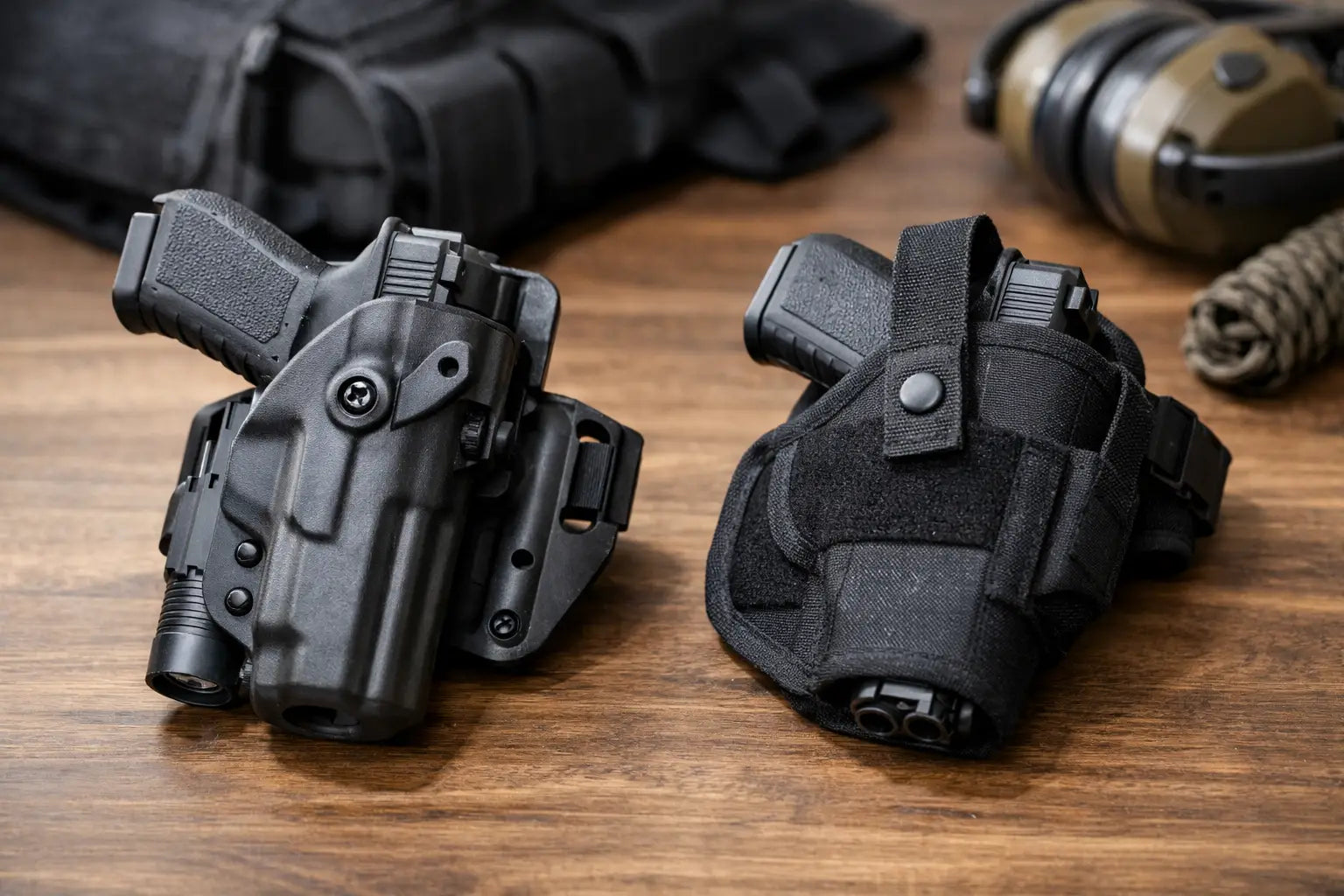
The simplest way to frame safariland vs universal holsters is this: Safariland builds many holsters around a specific firearm and often a specific light, optic, and retention configuration, while universal holsters are designed to accommodate a wider range of handguns through adjustable tension, flexible material, or generalized sizing.
That difference changes everything. A model-specific holster typically gives you more precise fit, a cleaner draw path, and stronger retention predictability. A universal holster gives you broader compatibility, easier sharing between firearms, and often a lower barrier to entry on price.
Neither category is automatically better for every buyer. If you carry one pistol on duty every day, a dedicated fit usually wins. If you rotate firearms, need a stopgap solution, or want a range holster for several handguns, universal options become more attractive.
Why Safariland Is the Standard for Duty Use
Safariland has a strong reputation in public safety because its holsters are built around retention performance and repeatability under stress. That matters when your sidearm is exposed in crowds, during hands-on activity, or in close quarters where a weapon grab is a real concern.
Many Safariland holsters use established retention systems that combine passive hold with active mechanisms. That gives the user a holster that does more than simply clamp down on the trigger guard. It creates a consistent release sequence that can be trained, measured, and trusted over time.
For duty roles, that consistency is hard to overstate. Officers and security professionals are not just looking for a holster that holds the gun. They need one that stays secure during movement, works with their draw stroke under pressure, and supports the exact pistol setup they carry, including weapon lights and red dot optics if applicable.
Another advantage is integration with duty gear. Safariland setups often pair well with belt systems, drop platforms, ride height options, and accessories already common in law enforcement and security use. For an end user building a complete duty belt, that ecosystem matters.
Where Universal Holsters Make Sense
Universal holsters appeal to buyers for a reason. They solve practical problems quickly. If you own multiple handguns, need a temporary carry solution, or want one holster for basic range use, a universal design can provide flexibility without requiring a dedicated holster for each pistol.
They are also common for casual users who do not need duty-grade retention. A range shooter may value simple fit and affordability more than advanced retention features. Someone using a holster for occasional open carry on private property, training days, or non-professional applications may be comfortable with that trade-off.
Some universal holsters are also easier to source when you are dealing with less common pistol models or transitional setups. If your firearm configuration changes often, a universal option can feel more forgiving than replacing a dedicated holster every time you change a light or move to a different handgun.
That said, flexible fit is not the same as optimized fit. Universal holsters often work across several guns by accepting compromise. The draw may be less clean. The retention may feel acceptable with one pistol and marginal with another. The bulk may increase because the design has to accommodate variation.
Retention Is Where the Gap Gets Real
If this decision involves duty, armed security, or any environment where firearm retention is a serious operational issue, this is where the conversation usually ends. Safariland generally has the advantage.
A purpose-built retention holster is designed around the dimensions of the firearm and the release mechanics of the holster itself. That leads to more predictable performance during sprints, physical contact, awkward body positions, and one-handed reholstering.
Universal holsters usually rely more heavily on friction, adjustable screws, straps, or broad locking designs that are not as precisely tuned to a single handgun. Some are perfectly serviceable for light use. Few inspire the same confidence for professional applications where a sidearm must stay put until the exact moment the user intends to draw.
This does not mean every universal holster is unsafe. It means the margin for variation is wider. If your work requires retention levels beyond basic concealment or casual carry, broad compatibility can become a liability rather than a feature.
Fit, Draw Speed, and Reholstering
A dedicated holster usually feels better because it is built for one job. The pistol seats the same way each time. The draw angle stays consistent. Reholstering tends to be smoother because the mouth and internal shape support the firearm instead of merely accommodating it.
That can sound like a small detail until you repeat the motion hundreds of times in training or do it after a high-stress event. Efficient reholstering matters, especially when you need to keep your eyes up and maintain awareness.
Universal holsters can feel fine in a static setting, but they often show their limitations once movement, speed, and repetition enter the picture. Some collapse more than expected. Some shift on the belt. Others create an inconsistent draw because the gun is not indexed exactly the same way every time.
Comfort and Everyday Wear
Comfort is not just about padding or weight. It is about how the holster rides over a full shift, in and out of a patrol vehicle, through building searches, perimeter work, and long periods on your feet.
Safariland holsters can be larger and more structured than minimalist universal designs, especially in duty configurations. That extra structure may add bulk, but it often pays you back with stability and a more secure ride. For professionals wearing a full belt setup, that trade can be worth it.
Universal holsters sometimes feel lighter or less restrictive at first, especially for casual users. But if the holster shifts, prints awkwardly, or requires constant adjustment, that early comfort advantage fades fast.
This is one of those it-depends categories. A plainclothes user with a simple pistol and light use pattern may prefer a compact universal option. A uniformed officer or armed guard usually benefits more from the stability of a dedicated system.
Cost vs Value
Universal holsters often win on initial price. If your only goal is getting a handgun on your belt for occasional use, that matters. Buying one adjustable holster instead of several dedicated models is an obvious cost saver.
But duty gear should be judged on service life, not shelf price. A holster that supports safer retention, cleaner draws, better durability, and mission-specific fit can offer better long-term value even if the upfront cost is higher.
That is especially true when the holster is part of a professional loadout. Saving money on a piece of equipment you trust with weapon security every day is not always good value. It is just a lower purchase price.
Who Should Choose Which
If you are law enforcement, armed security, corrections, or anyone working in an environment where retention standards matter, Safariland is usually the stronger choice. The same applies if you carry one primary handgun and want a holster matched to that exact setup.
If you are a range user, firearm owner with multiple pistols, or someone looking for a general-purpose solution for lighter use, a universal holster may be enough. The best choice depends on what the holster has to do when things get physical, fast, or unpredictable.
For buyers outfitting around real field use, it helps to shop with a retailer that understands those application differences. AE Tactical serves public safety professionals and tactical users who need gear selected around mission requirements, not guesswork.
Safariland vs Universal Holsters for Lights and Optics
This is another area where dedicated holsters tend to separate themselves. Once you add a weapon light or red dot optic, fit becomes more demanding. The holster has to clear the optic, account for the light body, and still retain the pistol correctly.
Safariland has a clear advantage here because many models are built around specific firearm and accessory combinations. That gives users more confidence that the holster will fit and function as intended.
Universal holsters can sometimes accommodate lights and optics, but results vary. A holster that claims broad compatibility may technically fit your setup while still feeling loose, awkward, or inconsistent on the draw. If your pistol is accessorized and carried professionally, broad compatibility is rarely the priority.
The right holster is the one that matches your actual use, not the one that sounds the most flexible on paper. If your sidearm is part of your job, dedicated fit and retention usually earn their place quickly. If your needs are lighter and your firearm lineup changes often, a universal holster can still be a practical tool. Buy for the role, train with what you carry, and let performance make the decision.